Analytics & CRO · · 4 min read
Shopify AI store builder: fast to build, slow to trust
The Shopify AI store builder makes a store in seconds. Trust takes longer. Why AI looking stores lose shoppers and how to prove your brand is real.
By Nikita Ahapov · Updated
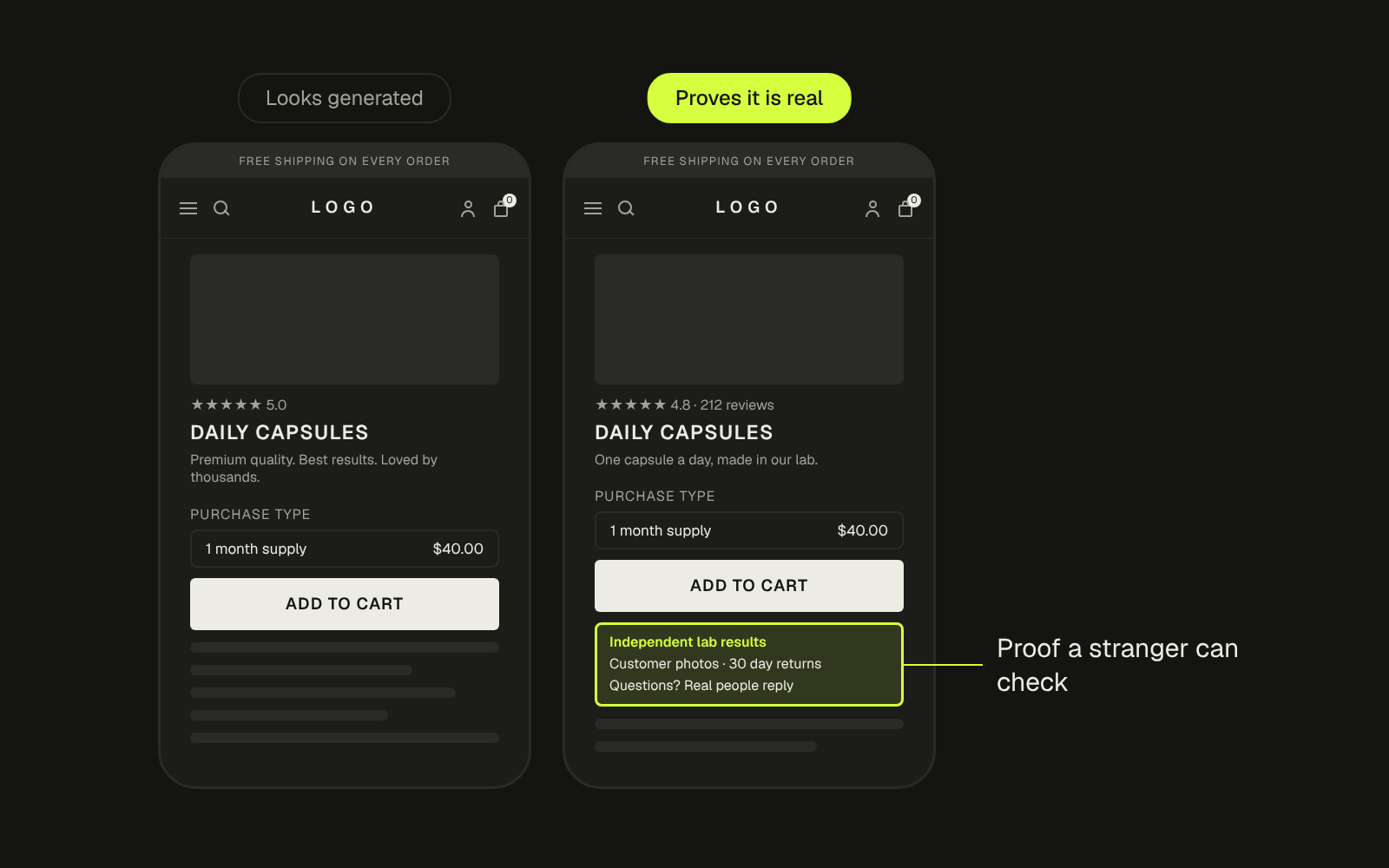
The Shopify AI store builder can give you a store design in seconds. I have nothing against it. What worries me is what I keep seeing on the other side: more and more stores that are AI from top to bottom. AI images, generic copy, cheap products marked up five times.
The problem is not AI. The problem is trust.
The problem: every fake store makes the next real one look suspect
A shopper who gets burned by a store that looked fine does not only stop trusting that store. They get more careful with the next one. And the next one might be yours.
So real brands now carry a new job. You have to prove the product is real, the images are real and the business behind them is real. Before, a clean theme and a few five star reviews were enough to look legit. Now a clean theme is exactly what a generated store has too.
Why it happens
Making a store has never been easier. Shopify’s help center has a page called “Generate a free theme with AI”: you describe your business, tap Generate themes, and you can generate up to 3 free personalized themes that land in your Draft themes. (Shopify Help Center) Shopify’s own tool page puts it simply: describe your business in a few words to generate personalized store designs for free. (Shopify)
That is great for a real founder who needs a starting point. It is just as easy for someone who wants a store that looks real for a few weeks.
The result is that the look of a store no longer tells a shopper much. Polish used to be a signal of effort. Now it is free.
Are AI Shopify stores legit?
Some are, some are not. A store built with AI can belong to a real business with real stock and a real person answering email. The tool does not decide that. What decides it is everything the AI did not make: the product, the photos, the policies, the people.
There is also a line you cannot cross. The FTC’s rule on fake reviews names AI generated fake reviews directly and prohibits businesses from creating or selling them, or buying them when they knew or should have known they were fake. (FTC) If your reviews section was filled by a generator, that is not a trust problem. That is a legal one.
How to tell if a Shopify store is legit
Shoppers are being taught what to check. The FTC’s holiday shopping advice says unusually low prices are a sign of a scam, and tells people to search the seller’s name plus words like “review,” “complaint,” or “scam” before buying from an unfamiliar seller. It also says to look at the refund policy, who pays for return shipping, and whether there is a restocking fee. (FTC Consumer Advice)
So check your own store the way a careful stranger would:
- Search your brand name plus “scam” and “review”. See what comes up first.
- Open a product page on your phone. Is there anything a generator could not have written? A real photo, a measurement, a test result, a name?
- Read your reviews. Do they have photos, details and the odd four star, or are they all short and perfect?
- Find your refund policy from the product page. Count the taps.
- Look for a way to reach a person. An email address, a chat, an address.
- Add to cart and go to checkout on your phone. Does anything jump, overlap or break?
How to fix it: prove the product, the images and the brand
Do not hide that you use AI. Just make sure the proof sits where people decide.
- Prove the product. Real numbers instead of adjectives. Dimensions, materials, test results, what is in the box. Next to the button, not three tabs down.
- Prove the images. At least some photos that are clearly yours. Customer photos in reviews do this better than any studio shot.
- Prove the brand. A real about page, a support email that answers, a returns policy written for your store and not left as a template.
- Price honestly. A product marked up five times with a fake strike through price is exactly what shoppers are learning to spot.
I wrote about what builds trust in a Shopify store before, and value perception still comes first. Proof is how you make value believable.
What I do
I use AI every day. It makes building faster. But I have also seen what comes out of a generated store when you look closely. The cart behaves weird on mobile. Layouts break between breakpoints. The smart section needs 20 tweaks before it does what it should.
AI makes building faster. Judgment still makes stores work. That judgment is the part I do: a store that a real shopper on a real phone can trust and buy from without friction.
If you want a second look at yours, send me your store and I will tell you where it reads as generated and what proof to add first.