Analytics & CRO · · 4 min read
How to build trust in ecommerce: fix value first
How to build trust in ecommerce, from Judge.me's study of almost 7 million Shopify store reviews: perceived value beats delivery speed. What to check first.
By Nikita Ahapov · Updated
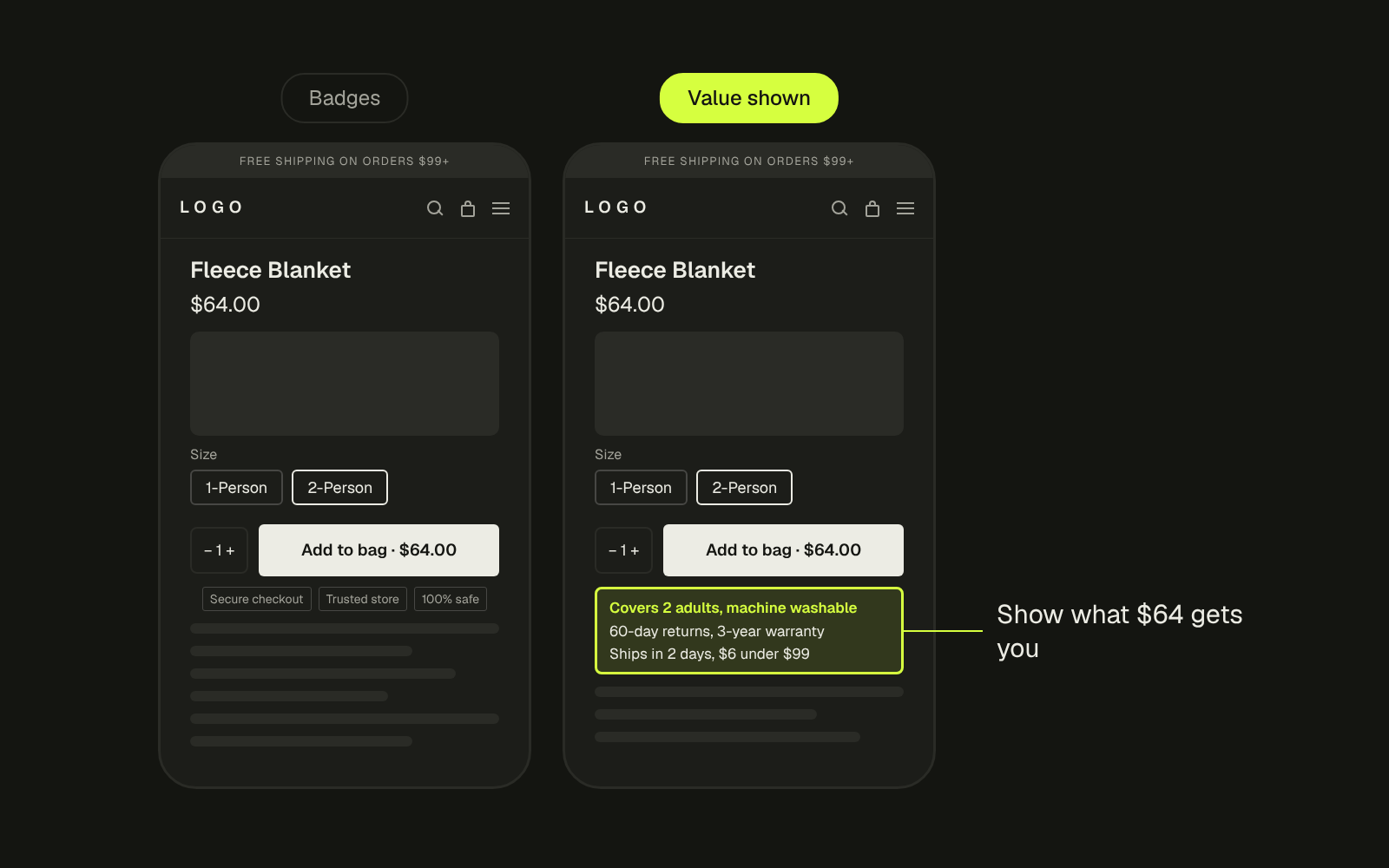
How to build trust in ecommerce is usually answered with a list: trust badges, faster shipping, a bigger support team. When I audit a Shopify store, I see those added one after another while the product page still does not answer the question shoppers actually ask. Is this worth the money?
Some brands ship slowly and still have loyal customers. Now there is data that explains why.
The problem: stores fix the wrong thing
Judge.me, a reviews app used by more than 600,000 Shopify stores, studied almost 7 million reviews written between May and September 2025. It measured how strongly four things move the overall tone of a review. (Judge.me)
- Perceived value: 0.82
- Product excellence: 0.77
- Service excellence: 0.53
- Delivery: 0.38
Judge.me defines perceived value as “the customer’s judgment of whether the product was worth the money”. Inside that group, “value for money” alone carries roughly three times the impact of the next strongest driver.
Two caveats before you act on it. These are regression coefficients from review text, so they show what moves together, not proof of cause. And they only cover people who left a review, which the report itself lists as a limitation.
Why value beats fast shipping
The report puts it in one line I agree with: “When value perception is strong, minor issues remain minor.” A late parcel gets forgiven when the product felt worth it. When it did not, every small thing becomes a complaint.
The price complaints are the interesting part. In the lowest sentiment reviews, customers mention price 4.5 times more often than in the highest. Judge.me’s reading is that “price” stands in for something else: a product that felt cheaper than the page promised, a delayed delivery, a return that took effort. Discounting does not fix any of those. It only lowers your margin.
Delivery still matters, just differently. When product sentiment is strong but delivery is poor, overall sentiment drops from 4.42 to 3.75 out of 5. So the target is delivery that is “good enough” and predictable, not the fastest in your market.
Do trust badges help a Shopify store?
A row of badges under the buy button is the most common trust fix I see. Baymard’s checkout research found that 19% of users had abandoned a checkout in the last three months because they did not trust the site with their card details. But the same research says that worry shows up when shoppers reach the credit card fields, not on steps that only ask for an address or shipping method. It also files homemade “Secure Checkout” badges under made up symbols: the site claiming it is safe. (Baymard)
So a badge row on the product page answers a question the shopper is not asking yet. Hidden costs are a bigger leak. Leaving aside shoppers who were just browsing, Baymard’s top reason for abandoning a cart is “Extra costs too high (shipping, tax, fees)”, well ahead of not trusting the site. (Baymard)
How to check your own store
- Read your bad reviews for the word price. Search your 1 to 3 star reviews for “price”, “worth”, “expensive” and “money”. Then read the rest of each review. Late, smaller than expected, hard to return? That is the real problem.
- Read your 3 and 4 star reviews. Look for “a bit tricky” or “took a while”. Judge.me calls frequent mentions with neutral tone hidden friction: not broken enough to complain about, not smooth enough to forget.
- Open a product page on your phone. Look at what sits next to Add to cart. Does it say what the price buys, how returns work, when it arrives and what shipping costs? Or only badges?
- Compare the page with the parcel. Order your own product. If the photos promise premium and the box feels flimsy, that gap is what shoppers call “not worth it”.
How to fix it
Make value visible where the decision happens. Next to the buy button, put the few facts that justify the price: size, materials, what is included, the guarantee, the returns window. I wrote about what top product pages put next to Add to Cart if you want the full list.
Show shipping cost and timing before checkout, and promise only what you meet. The report found customers respond better to realistic timeframes that are kept than to ambitious ones that slip. A delivery date on the product page does this well when it is honest.
When reviews complain about price, fix the cause they describe, then answer the review and remind the customer what the product includes. Cut the price last, not first.
What I do
On an audit I start with the reviews, not the theme. I group the price complaints by what is really behind them, then check the product page for each one: is the answer there, near the button, on a phone? Badges and countdown timers come off if they add noise. Then the page gets the facts that make the price make sense.
If your store sells the same product as others, value is even harder to show. Here is how to stand out with white label products.
Want me to read your reviews and product page with you? Send me your store and I will tell you where value gets lost.