Analytics & CRO · · 4 min read
How to sell white label products when competitors do too
How to sell white label products when three other stores have the same item: one reason to buy from you, your own photos, and the details lazy stores skip.
By Nikita Ahapov · Updated
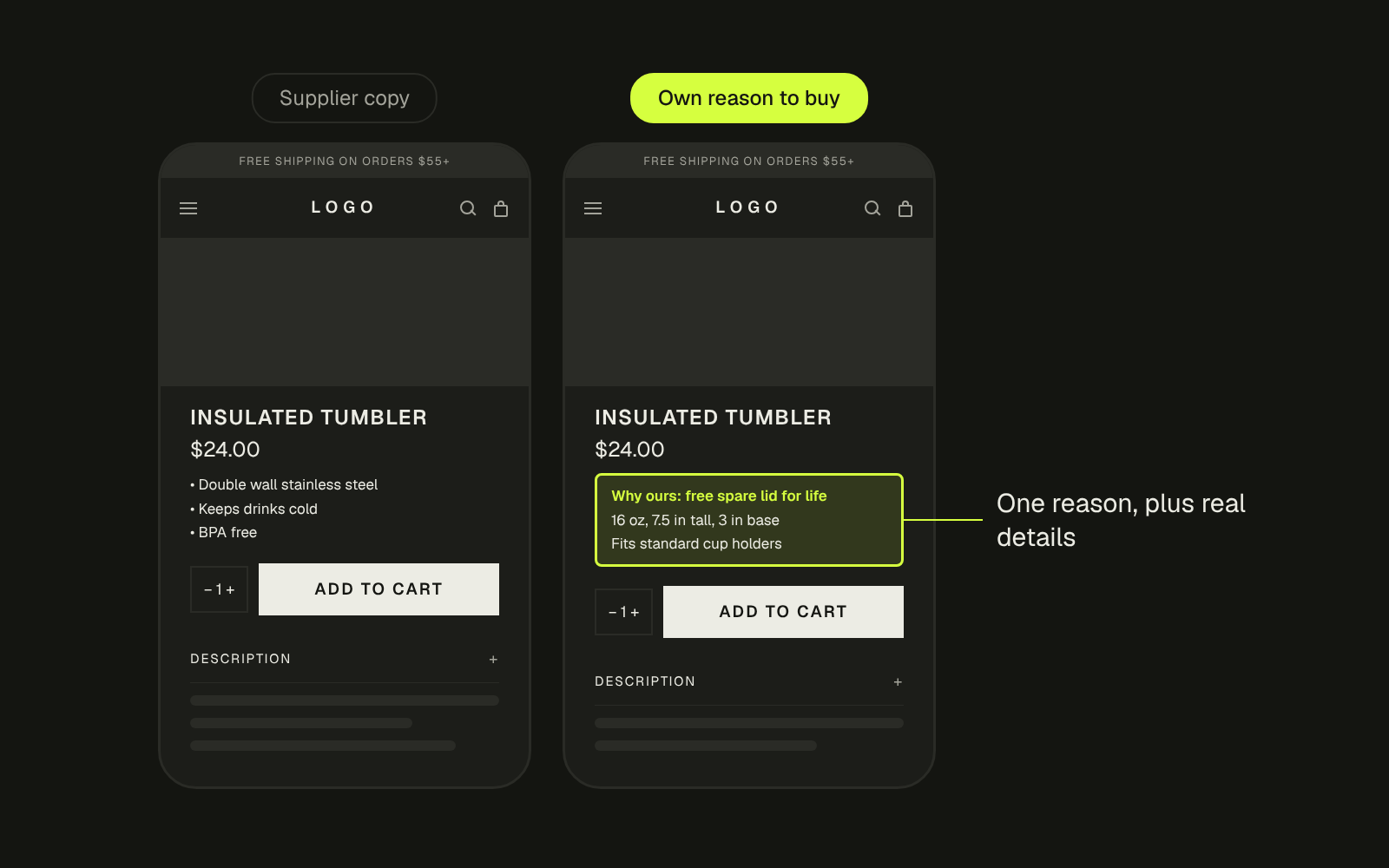
How to sell white label products is not a sourcing question for most stores I audit. It is a product page question. When I audit a Shopify store, I check its competitors, and I often find three more stores selling the exact same product. Same supplier photos, same specs, only the logo is different.
If a shopper opens those four tabs side by side, nothing tells them which store to pick. So they pick the cheapest one.
The problem: four stores, one product page
A white label product is made by someone else and sold under your brand. That is the point of it: you skip product development and launch fast. The catch is that the supplier sells the same thing to anyone who asks.
Shopify’s own guide puts it plainly: white label products “can be sold by multiple retailers, including competitors.” It also says that with white label, your company “has no hand in the design, development, or production process.” (Shopify)
So the product cannot be your difference. The page has to be.
Why everyone ends up looking the same
The fastest way to launch is to copy what the supplier gives you. Their photos, their bullet points, their title. Every store that buys from them does the same, so the pages match.
Then the features stop working as a reason. Peep Laja at CXL writes that “Once novel features are now table stakes” and that “any feature that’s meaningful and popular gets copied.” (CXL) Double wall steel and keeps drinks cold sounded special once. Now every tumbler says it.
When every store looks the same, people choose by price, and a price fight has no winner. The same CXL piece says it well: “anyone can mark down a price.”
White label vs private label: what changes
If you keep losing on price, it is fair to ask whether you should move to private label. The difference is exclusivity. Private label is made to your spec for your brand, and Shopify notes that private label contracts often include exclusivity agreements so the maker cannot sell your product to other brands. (Shopify)
That costs more and takes longer. For most stores I see, the cheaper step comes first: make the white label page clearly yours.
How to check your own store
- Copy your product title and one line of your description. Search it in Google. Count how many other stores show the same words.
- Run a Google image search on your main product photo. If the same shot comes up on other stores, shoppers have probably seen it too.
- Open your page and a competitor’s page side by side on your phone. Cover the logos. Can you tell which one is yours?
- Read your page as a shopper and find the one sentence that says why to buy here and not there. If you cannot find it, neither can they.
If you swapped logos with a competitor and no one noticed, that is what you need to fix.
How to make your Shopify store stand out
Take your own photos. Brands that shoot their own photos already look different from every store using the supplier’s set. Baymard’s work on product images starts from a simple fact: “You can’t touch and feel the product, you can’t smell it or pick it up and turn it around.” Images do that job. They also list types of images that help, like size and proportion shots with a hand or a familiar object, close ups of texture, and photos from customers. (Baymard) A supplier rarely gives you those.
Give one clear reason to buy from you. Not five. One sentence near the price that a competitor cannot copy by editing a line: a guarantee you actually honour, a bundle, faster dispatch from your own stock, a spare part for life. Put it next to Add to Cart, where people make the call. I wrote about what top product pages put next to Add to Cart.
Add the product details lazy stores skip. Real dimensions, what it fits, how to clean it, what is in the box. In Baymard’s testing a user dropped one chair for another because the second description included dimensions, and some users “would move on to a different site” when the information they needed was missing. (Baymard) If the other three stores copied the supplier’s three bullets, your full spec is already a reason to stay.
Use a design that is not the default theme. Four stores on the same free theme with the same photos look like the same store. You do not need a full rebuild. Here is when a custom theme is worth it and when a paid one is enough.
What I do
On an audit I put the client’s product page next to every competitor that sells the same item. I mark what is identical: photos, title, bullets, layout. Then we pick one reason to buy, write it into the buy box, and add the details the others left out. Photos come next, because they take the longest.
Selling the same product as three other stores? Send me your store and I will show you where your page looks like theirs.